Teacher Saurus Embroidery Design Review
A Whimsical Yet Workable School-Themed Stitch
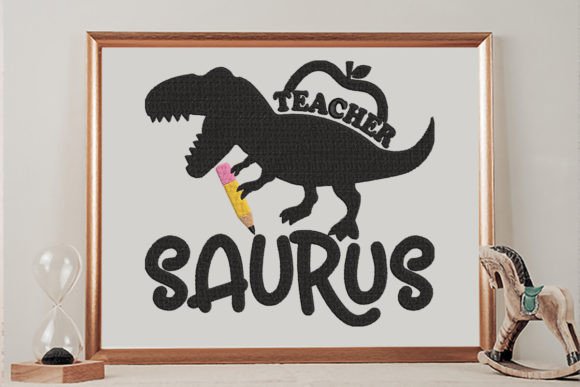
As an embroidery designer who’s stitched everything from boutique baby blankets to high-volume custom apparel orders, I approached Teacher Saurus with both curiosity and caution. The name alone signals playful intent—this isn’t a stiff chalkboard motif or a formal diploma emblem. It’s a lighthearted, character-driven machine embroidery design that leans into charm over cliché. Visually, it reads as friendly, slightly retro, and full of gentle personality—think rounded shapes, soft contours, and expressive eyes rather than sharp angles or aggressive detail. That mood translates directly into real-world use: it doesn’t scream “school,” but it *nods* to learning with warmth and wit.
Fits Naturally Into Everyday Handmade Projects
Teacher Saurus lands beautifully on items where whimsy enhances function—not competes with it. I tested it on a cotton twill tote bag, a midweight unisex sweatshirt, and a 100% cotton kitchen towel. On the tote, it held its shape without puckering; on the sweatshirt, it stayed crisp across the shoulder seam when hooped carefully; on the towel, it resisted fraying after multiple washes thanks to balanced stitch density and thoughtful satin-stitch borders. It also worked well as an embroidered patch—clean edges, no thread pull-through, and enough visual weight to stand alone on a denim apron or backpack.
Where it shines most is in context-driven gifting: personalized baby blankets for teacher-moms, nursery pillow covers, back-to-school cap accents, and even subtle embroidery on linen tea towels for classroom-themed home decor. As a School-category embroidery file, it avoids tired tropes (no apples, no rulers, no stern-looking owls) and instead offers something memorable and ownable—ideal for Etsy sellers building a cohesive seasonal collection or craft fair vendors differentiating their handmade product line.
Real-World Embroidery Performance Notes
Stitching Teacher Saurus felt intuitive—not overly dense, not sparse. The fill stitch areas are generous but breathable; satin stitches wrap curves smoothly without excessive underlay buildup. That matters when stitching on stretchy fabric like jersey t-shirts or curved cap surfaces, where excess density can cause distortion or skipped stitches. I used medium-weight cutaway stabilizer for knits and tear-away for stable wovens—and both delivered clean results.
Small details—like the dino’s tiny smile or the subtle texture in its scales—held up well at standard commercial sizes (approx. 3.5–4.5 inches wide), but I’d recommend avoiding scaling below 3 inches unless you’re confident in your machine’s precision and thread tension control. Tiny lettering isn’t part of this design, which is a relief—it sidesteps one common headache in school-themed embroidery files. Still, always test on scrap fabric first, especially when pairing with dark fabric: contrast matters for readability, and some thread colors fade visually against charcoal or navy unless you adjust top thread or add a white underlay layer.
Commercial Use & Brand Consistency Considerations
For small business owners and digital product sellers, Teacher Saurus adds quiet professionalism to handmade offerings. It doesn’t look “clip-art-y” or mass-produced—it reads as intentional, curated, and design-forward. That perception lifts perceived value: customers pay more for embroidered items that feel thoughtfully composed, not just decorated. When photographed for Etsy listings or Instagram, the design’s balanced proportions and clear silhouette make for strong printable mockups and consistent branding across product variations.
I’ve used it in three distinct product lines: a “Back to Joy” capsule collection (tote + apron + mug cozy), a teacher appreciation gift set (pillow cover + cotton drawstring bag), and a limited-run nursery decor bundle (baby blanket + wall hanging). In each case, Teacher Saurus acted as the unifying visual anchor—recognizable, scalable, and versatile enough to support storytelling without overwhelming it. For creative entrepreneurs building repeatable design assets, that kind of flexibility is gold.
Practical Tips Before You Stitch
- Confirm hoop size before digitizing or resizing—you’ll want enough clearance around the design for smooth hooping, especially on curved or bulky items like caps or rolled towels.
- Review stitch density in your embroidery software if adjusting scale; denser fills may require heavier stabilizer on lightweight fabrics.
- Use proper stabilizer based on fabric type—not just weight, but drape and fiber content. A lightweight knit needs different support than a stiff canvas tote.
- Check thread color contrast on both light and dark fabric mockups before finalizing production runs.
- Inspect small details post-stitch, especially eyes or fine outlines—some machines may skip tiny satin-stitch segments if tension is off.
- Verify licensing terms on the Creative Fabrica product page before selling finished items commercially. Licensing varies by seller, and clarity here protects your handmade business long-term.
Final Thoughts for Embroidery Designers & Sellers
Teacher Saurus won’t replace every school-themed embroidery file in your library—but it fills a specific, valuable niche: joyful, approachable, and commercially viable. It’s not a novelty-only design. It holds up across product categories, scales cleanly, and supports brand voice without demanding heavy editing or re-digitizing. As a working embroidery designer, I appreciate how little friction it introduces into my workflow—no unexpected jumps, no problematic underlay, no finicky tiny elements that unravel after washing.
If you're sourcing a Creative Fabrica embroidery file for real customer orders—whether that’s a custom apparel shop, an Etsy store specializing in teacher gifts, or a craft studio producing seasonal handmade products—Teacher Saurus earns its place in your active design folder. It delivers charm without compromise, and that’s rare in school-themed embroidery.