Teachers Change the World One Child
A Practical Embroidery Designer’s Review for Small Business Merch
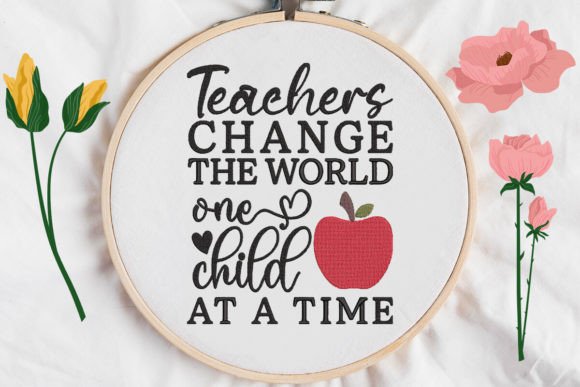
As an embroidery designer who’s developed hundreds of commercial embroidery files for small businesses—from indie cafés and florists to boutique schools and handmade studios—I approached Teachers Change the World One Child with a dual lens: artistic impression and real-world production viability. This isn’t just another whimsical machine embroidery design—it’s a statement piece with clear brand potential for education-adjacent businesses, creative studios, and community-focused brands.
First Impression: Friendly, Uplifting, and Professionally Whimsical
The title alone—Teachers Change the World One Child—immediately signals warmth, purpose, and quiet confidence. Based on the description (“Add a touch of charm… fun and whimsical accent”), I expected a clean, legible script or hand-drawn font with subtle illustrative elements—perhaps a chalkboard texture, a pencil icon, or soft star accents. It reads as friendly but not childish, whimsical but not cluttered, and handmade in spirit without sacrificing polish. That balance is rare—and critical—for small business merch where credibility and charm must coexist.
Where It Shines in Real Business Use
This embroidery file excels where emotional resonance meets everyday utility. For a local bakery that partners with school PTA groups? A 2.5” embroidered patch stitched onto canvas aprons says “We support learning”—without being literal. For a craft studio offering teacher appreciation kits? Teachers Change the World One Child works beautifully as a chest logo on organic cotton tees or as a sleeve detail on denim jackets—small enough to feel intentional, large enough to read at arm’s length.
- Embroidered patches: Ideal for iron-on or sew-on application on tote bags, backpacks, and staff lanyards—especially when paired with complementary design assets like simple apple or book motifs.
- Apron embroidery: Sits cleanly above the pocket on medium-weight twill or linen-cotton blends. Its vertical rhythm avoids distortion on curved waistbands.
- Cap embroidery: Works best on structured front panels (not curved bill edges), especially in simplified versions—more on that below.
- Tote bag design: Stands out on natural canvas or unbleached cotton, reinforcing a handmade product ethos without competing with other branding.
- Product packaging accents: When stitched onto fabric gift tags or reusable pouches included with Etsy orders, it adds tactile authenticity to digital-first sales.
Use With Intention: Key Considerations for Commercial Embroidery
While Teachers Change the World One Child carries strong emotional appeal, its effectiveness hinges on thoughtful execution—not just placement. Here’s where attention matters:
- Small patch sizes: Below 2” tall, fine lettering or delicate outlines may blur. Always test stitch a 1.75” version before bulk production.
- Cap embroidery: Front panels require simplification—avoid tight kerning or thin serifs. Confirm the file includes or allows for a condensed variant.
- Curved surfaces & textured fabric: On knit caps or terry cloth towels, higher stitch density can cause puckering. Pair with cutaway stabilizer and reduce density if needed.
- Dark uniforms: Light thread colors (ecru, pale yellow, soft grey) often read better than stark white—test contrast against your actual fabric swatch.
- Frequent washing: If used on staff aprons or reusable merch, verify satin-stitch coverage and underlay stability. Loose fills won’t hold up over 50+ wash cycles.
How It Strengthens Brand Identity and Customer Trust
In small business merch, every stitch communicates values. Teachers Change the World One Child doesn’t shout—it invites. That subtlety builds trust: customers recognize sincerity over salesmanship. When a florist includes this embroidered patch on their delivery totes, it quietly aligns them with care, growth, and long-term impact—not just transactions. For Etsy sellers, it elevates perceived value: a handmade product paired with a meaningful, professionally digitized embroidery file signals intentionality and craft-level respect.
It also supports visual consistency across touchpoints. Use it as a chest logo on staff tees, then scale down for woven labels inside aprons or as a printable mockup on social media—same message, same tone, different context. That cohesion makes your brand feel considered, not cobbled together.
Essential Embroidery Designer Notes Before Production
Before you load Teachers Change the World One Child into your embroidery machine or send it to a decorator, run these checks:
- Test stitch in black and white first—assess legibility, spacing, and flow without color distraction.
- Verify it scales cleanly to your smallest intended use (e.g., 1.5” for cap fronts or 2” for standard patches).
- Review thread color recommendations—or choose high-contrast pairings yourself (navy + cream, charcoal + mustard, forest green + oat).
- Inspect letter spacing: tight tracking can collapse in dense satin stitch; open it slightly if needed.
- Confirm hoop size compatibility—especially if stitching on curved or bulky items like tote bag handles.
- Test on your actual fabric: a cotton poplin behaves differently than fleece or canvas. Adjust tension and stabilizer accordingly.
- Create a physical or digital mockup for client approval—this avoids misaligned expectations on scale, texture, or tone.
- Compare it beside your other design assets: does it harmonize with your logo, typography, and overall School or Embroidery category aesthetic?
- Double-check commercial licensing—since this is intended for small business merch, custom apparel, and resale, confirm the digital embroidery file permits commercial embroidery use.
Remember: Teachers Change the World One Child isn’t just decoration. It’s a brand amplifier—one that works hardest when treated with the same care you’d give your own mission statement. Whether stitched on a teacher’s tote, a café’s apron, or a boutique’s limited-run capsule, it turns fabric into meaning. And in today’s market, that kind of resonance isn’t whimsical—it’s essential.